Automation Levels in a Modern Brewhouse
HGMC publishes modern brewhouse control in three levels: a PID display control panel, a PLC semi-automatic touch screen, and a PLC fully automatic control panel with curve indication and production-record printing. The difference between them is less about the beer than about who watches the mash, how much of the brew day is recorded automatically, and what happens when a new shift takes over the kettle.
This article sets out what each level does, what it costs you in staffing, and one piece of arithmetic on the operator hours a fully automatic panel returns.
Key takeaways
- Three published levels: PID display panel, PLC semi-automatic touch screen, and PLC fully automatic with curve indication and production-record printing.
- Automation covers mash, wort and water flow with automatic temperature control, which is what makes a recipe repeatable across shifts.
- Records are the quiet benefit: a printed production record is evidence of what the brew actually did, not what the sheet says it should have done.
- Published support around a control system includes installation, commissioning, operator training, maintenance support and spare parts supply.
The three published control levels
A PID display panel is the entry level. Temperatures are shown and controlled by loop controllers, and the operator manages the transitions: opening and closing valves, switching pumps, watching the mash and the boil. It is simple, it is repairable with locally available controllers, and it demands a trained person on the floor for the whole brew.
A PLC semi-automatic touch screen moves the sequence onto the controller. The operator starts a step and the panel runs it, prompting the next action, with temperatures and times held by the program rather than by hand. A recipe becomes a file rather than a habit.
A PLC fully automatic panel takes over the whole sequence, with curve indication on screen and production-record printing at the end of the brew. Mash, wort and water flows run with automatic temperature control, and the record of the curve is written out rather than drawn on a clipboard. That is the level a production brewery buys when two or three people brew in parallel and nobody can stand at one kettle all day.
What automation actually controls
The published description is specific: fully automatic mash, wort and water flow with automatic temperature control. Translated into a brew day, that means the controller manages the temperature steps of the mash, the transfer of wort from the lauter tun, the sparging water volumes and the knock-out temperature, holding each one to the recipe instead of to the operator's attention.
The design around the control matters as much as the panel. Published design notes describe jackets on both the body and the cone of vessels, pipework designed to avoid wort aeration, and a sizeable headspace with the cover headspace volume calculated separately, which is what keeps a vigorous boil and a high-gravity wort inside the vessel. Those details are the reason some plants can brew strong beers without foaming over the top, since the published equipment handles beers up to 33 Plato.
Records, training and the support around the panel
Curve indication and production-record printing sound like marketing until the first time a beer drifts and nobody can explain why. A printed record shows the actual mash temperatures, the times held at each step and the volumes transferred, so a batch that tastes different can be compared with the batch that tasted right. It also shortens the discussion with a distributor who asks whether the beer was made to the stated process.
The system is only as good as the people running it, which is why the published service list includes installation, commissioning, operator training, maintenance support and spare parts supply, with sales and engineers available 24 hours and the service offered around the clock. Training is not a formality on an automatic plant: the operator who does not understand the sequence cannot recover it when a valve sticks at the wrong step.
| Level | Operator role | Records | Fits |
|---|---|---|---|
| PID display control panel | Manages every valve, pump and transition by hand | Manual log or none | Nano and taproom plants with one brewer on site |
| PLC semi-automatic touch screen | Starts each step and confirms the next one | Step data held by the program | Small plants brewing several times a week |
| PLC fully automatic panel | Supervises the brew and intervenes on exception | Curve indication on screen plus printed production records | Production breweries running parallel brews |
| Support and service | Training, commissioning and maintenance across all three levels | Service history and spare parts list | Any size class from nano to large commercial |
Worked example: the operator hours a panel returns
My assumptions, stated so you can change them: a three-step mash held at 52, 63 and 72 degrees Celsius, a mash-in of 20 minutes, a 15 minute hold at 52 degrees, then ramps at 1 degree per minute, a 30 minute hold at 63 degrees and a 20 minute hold at 72 degrees, then a 60 minute boil that needs only occasional attention, and 60 brews a year.
Step one, ramp times. From 52 to 63 degrees is 11 kelvin at 1 degree per minute, so 11 minutes. From 63 to 72 degrees is 9 kelvin, so 9 minutes. Step two, the mash total: 20 plus 15 plus 11 plus 30 plus 9 plus 20 is 105 minutes.
Step three, attention. On a PID panel the operator watches essentially all of that mash, so 105 minutes a brew. On a fully automatic panel the same operator checks in for the start, the step transitions and the knock-out, which on my assumption is about 15 minutes in the room and 90 minutes free. Step four, over a year: 60 brews multiplied by 90 minutes is 5,400 minutes, or 90 hours, which is nearly twelve working days of attention moved off the panel and onto other jobs. Step five, the counterweight: automatic control does not replace the operator, because the panel still needs someone who can read the curve and act when it departs from the recipe, which is exactly what the training and commissioning service is published to cover.
Frequently asked questions
What control levels are available for a brewhouse?
Three are published: a PID display control panel, a PLC semi-automatic touch screen, and a PLC fully automatic control panel with curve indication and production-record printing. All three can be specified on electric, steam or direct-fire brewhouses in two, three, four or five-vessel configurations.
Does a fully automatic brewhouse run without an operator?
No. The panel runs mash, wort and water flow with automatic temperature control, but an operator still supervises the brew, reads the curve and intervenes when something departs from the recipe. Published support includes installation, commissioning and operator training for that reason.
Choose the level that matches your staffing
Count the hours of attention your current or planned brew day needs, then decide how much of that you want to buy back. The company publishes all three control levels across its hgmc brewing equipment, from the entry panel to the fully automatic version with printed records.
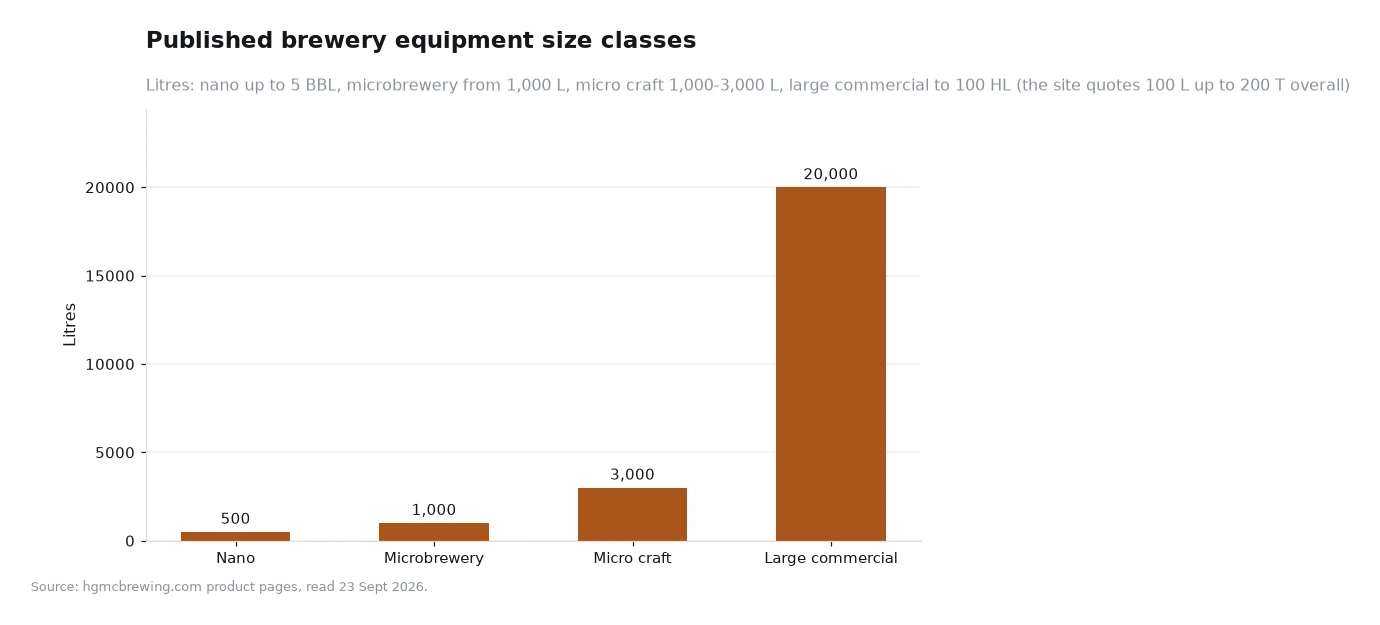
Before specifying a level, look at the brewhouse equipment configurations to see how vessel count and control interact, and check the micro craft brewing systems if your plant sits between 1,000 L and 3,000 L. Automation is one of the few decisions you can price cleanly before you buy, so it is worth settling early rather than upgrading later.
Published control levels, design notes, service scope and the 6-year warranty on tank accessories and electronic components against manufacturing defects come from the manufacturer's own website, read 23 Sept 2026; the mash timings and operator hours above are my own arithmetic from the stated assumptions.[1] Delivery runs from deposit to door delivery in 90 to 150 days depending on the order.