Brown Film vs Dark Film: Picking the Surface for Your Project
Surface film is the smallest line in a formwork plywood specification and the one that decides what the concrete looks like afterwards. The published range names three surfaces — Dark Brown Film, Black Film and Anti Slip Film — pressed over birch, eucalyptus, acacia, white hardwood, rubber or combi cores, in panel thicknesses from 18 mm upwards.
Key takeaways
- Three films are published: Dark Brown Film, Black Film and Anti Slip Film, all pressed onto the same families of core.
- Two film weights are quoted: 165 g/㎡ on the smooth-surface option, 130 g/㎡ on the lighter build.
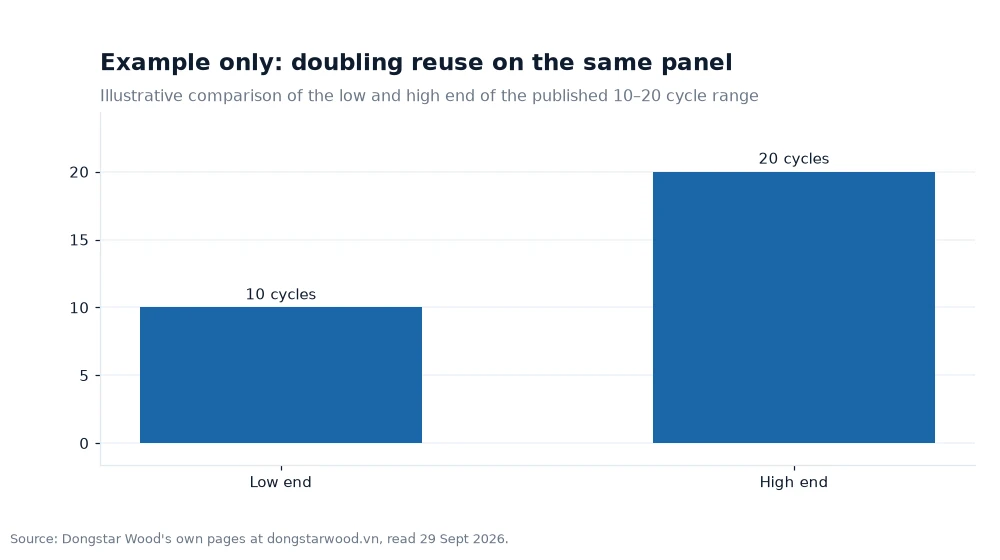
- The reuse band runs from roughly 3–5 pours on an ordinary black panel to 10–20 pours on a high-grade panel.
- A panel that is being walked on needs the textured anti-slip face rather than a smooth one, whatever the cost comparison says.
The film is the first surface concrete ever touches
Every mark that reaches a client's eye — a grain, a patch, a roller line — comes off the film rather than off the core. That is why surface selection sits with the person who owns the concrete specification, not only with the buyer who owns the budget, and why two otherwise identical panels can produce visibly different faces.
The film also controls release. A smooth phenolic surface lets the formwork come away cleanly after each pour, which reduces patching before a wall is handed over and keeps the next pour starting from a flat face. The published Film Faced Plywood description names three surfaces and two film weights, which is enough to write a specification line that can be checked on arrival.
Dark brown film: the visible-face default
Dark brown film is the surface most often chosen where the concrete will stay exposed. The published film weight of 165 g/㎡ is quoted for a smooth surface, and a heavier film is what keeps that smoothness stable across a run of pours rather than across the first two.
It survives cleaning better as well. Panels are scraped, washed and re-oiled between cycles, and a heavier film tolerates that routine without the surface breaking down into the texture underneath.
Black film: the workhorse for short-cycle work
Black film covers the economical end of the same product family. An ordinary black panel is quoted at roughly 3–5 reuse cycles, which suits foundations, temporary structures and packages where the face will be covered, rendered or hidden behind a finish.
Choosing it is a scheduling decision as much as a cost one. Where the programme is short and the concrete is not on show, the panel is not required to last a season; it is required to be on site, flat and available, and a lighter panel is also easier to handle between pours.
Film weight in numbers: 165 g/㎡ against 130 g/㎡
The two published weights describe different priorities. The heavier one, 165 g/㎡, is the smooth-surface spec that a visible concrete face calls for. The 130 g/㎡ build is lighter, and a panel carrying it is easier for a two-person crew to move and position.
Neither figure on its own predicts a cycle count. Reuse is published as a band from roughly 3–5 pours on an ordinary black panel up to 10–20 pours on a high-grade panel, and the film weight is one of several inputs into where in that band a delivered sheet lands.
Anti-slip film where people walk
The third surface in the range carries a textured hexagonal pattern pressed into the phenolic film. It is published for formwork that also serves as access: walkboards, scaffolding planking, temporary floors and platforms where a smooth face would be a slip risk in wet weather.
Those panels come in the standard formats (the 1220 × 2440 mm with 1250 × 2500 mm and 1500 × 3000 mm as the other two) and to custom sizes up to 1830 × 3830 mm, and the published adhesive options include WBP, melamine and E1/E0 classes.
Worked example: doubling the contact area of one panel
Start with a 1250 × 2500 mm sheet, which comes to 3.125 m² (1.25 m × 2.5 m). Over five pours that sheet delivers 5 × 3.125 = 15.625 m² of concrete contact (example). Over twenty pours it delivers 20 × 3.125 = 62.5 m² (example), four times the area from the same footprint.
Now size a wall package of 6,000 m² of contact area. At the economical end it needs 6,000 ÷ 15.625 = 384 panels (example); at the top of the range it needs 6,000 ÷ 62.5 = 96 panels (example). The arithmetic explains why the cheap panel is only cheap when the programme is short.
Putting the surface into the enquiry
| Surface | Where it fits | Question to put to the supplier |
|---|---|---|
| Dark Brown Film | Walls and slabs where the concrete face stays visible | Which film weight comes with this surface? |
| Black Film | Foundations, temporary works and covered faces | How many pours is this panel quoted for? |
| Anti Slip Film | Walkboards, platforms and access routes | Single-sided or double-sided texture? |
| Smooth reverse face | Panels that need grip on one side only | Which adhesive class is used? |
Write the answer into the order. A surface described by name, film weight and adhesive class can be checked at goods-in, while a panel described only as "brown film" leaves the buyer comparing two deliveries from memory.
Sampling settles more than a datasheet can. Order one sheet of each surface pressed on the same core, run them through three pours on the same wall, and film weight and stripping practice become the only variables left in the comparison.
Record what each panel looked like afterwards. Notes on colour, texture, edge swelling and how easily the concrete released give a buyer a record that outlives the person who made the original decision.
Where the budget is tight, split the set instead of downgrading all of it. Visible walls take the higher-grade surface, hidden and covered faces take the economical one, and the finished project still presents a consistent face to the client.
Then write the choice into a specification line that can be checked at goods-in: surface name, film weight, adhesive class and format. Anything less leaves the receiver comparing a delivery against memory, which is how the wrong panel ends up on the wrong wall.
Frequently asked questions
Which film leaves the smoothest concrete face?
The published smooth-surface option uses a 165 g/㎡ film, which is the heavier of the two weights quoted. Surface quality also depends on edge condition and release agent: a scored or swollen edge will mark concrete even when the film itself is intact.
Can brown and black film panels be used in the same formwork set?
They can, and many sites do it deliberately. High-grade panels go where the concrete stays exposed and economical black panels go where the face will be covered, which keeps the visible surfaces consistent while the hidden areas run on the shorter cycle count.
What decides whether a panel reaches twenty pours?
Four things together: core density, adhesive class, film weight and how the edge is treated between pours. The factory publishes core, glue and film options; edge sealing, careful stripping and flat storage are the parts that belong to the site.
Choosing the neighbouring panel
Two comparisons close out most surface decisions. Anyone specifying grip should read the textured anti-slip panel in full before fixing a format, and buyers who need the economical option in writing can check how the black film panel is built and where its cycle count sits.
The cycle counts and surface descriptions compared above are published by that the supplier's own site, as checked on 29 Sept 2026 and used in this article and used in this article for the numbers in this guide[1].