Plywood Cabinets in Humid Kitchens
Most cabinet failures in a humid kitchen begin at a cut edge, not on a door face. CasaBuilt's box is 1/2-inch birch plywood with a natural birch interior, finished on the outside with color-matched sides and seven layers of paint under a UV protective topcoat. The material and the coating answer two different parts of the same problem.
Key takeaways
- Water reaches a cabinet through seams and cut edges long before it reaches the painted face.
- Plywood is laminated from crossed veneers, so it resists the swelling that a glued chip panel shows at an exposed edge.
- The published box is 1/2 inch, the shelf and frame are 3/4 inch, and the finish is seven coats plus a UV topcoat.
- Base cabinet space runs from $29.13 to $40.78 per cubic foot across the published widths.
Where humidity attacks a kitchen cabinet
A kitchen is the wettest room in most homes, and the wet does not arrive as a flood. It arrives as steam from a boiling pot, spray from a tap, condensation on a cold exterior wall, and warm damp air pushed out of a dishwasher at the end of a cycle. Cabinets sit in that air for years, absorbing and releasing moisture with the seasons.
The face of a painted door handles this well. Paint is a barrier, and seven coats of it with a UV topcoat is a thicker barrier than most. The vulnerable points are the ones the paint does not cover: the bottom edge of a sink base, the back panel against an outside wall, the screw holes behind a hinge, and the cut edges where a panel meets another panel.
That is why the material of the box matters more than the material of the door in a humid room. A door can be wiped dry in a second. A box has to survive damp air reaching places no cloth can follow.
Why a plywood box moves less than a panel board
Plywood is made from thin veneers glued in alternating directions. Each layer pulls against the one below it, so the panel as a whole expands and contracts far less along its face than a single piece of wood of the same size would. The glue lines also slow the movement of moisture through the thickness of the panel.
A glued chip panel, usually sold as furniture board, is a mat of wood particles bound with resin and faced with a decorative sheet. It is flat and cheap to machine, and it performs acceptably in a dry room. At a cut edge it behaves differently: water enters the exposed particles, they swell, and the panel does not return to its original thickness when it dries. The damage is permanent and usually invisible until the edge crumbles.
MDF, a dense fiber panel, swells more slowly and recovers less. Where a cabinet is built from either material, the cut edges need sealing, and any leak needs attention within days rather than weeks. Plywood is not immune to water, but its structure gives a slow leak more time before the damage becomes structural.
The published specification uses that plywood in the places that stay hidden: the box, the shelves and the back. CasaBuilt lists the whole construction across its plywood rta cabinets range, including the 1/2-inch box and the 3/4-inch shelf, so the parts that face the damp can be checked before the order.
The finish, the cut edges and the wet zones
Seven layers of paint with a UV protective finish is a furniture finish, not a marine coating. It keeps a white door from yellowing in sunlight and it sheds splashes, and it does nothing for a panel edge that has been cut and left raw. In a humid kitchen the practical work is keeping water away from those edges in the first place.
Three places deserve attention. Under the sink, where a supply line or a trap can weep for months without being noticed, the bottom of the cabinet is the first thing to suffer. Around the dishwasher, where steam escapes at the end of every cycle, the side panel of the adjacent cabinet takes repeated damp air. Against an exterior wall, where the wall itself can be colder than the room, condensation forms on the back of the box and has nowhere to go.
The fixes are ordinary and cheap: check the trap and the supply connections once a year, leave a small gap between the cabinet back and a cold exterior wall rather than pressing the box against it, and keep the room vented while cooking. CasaBuilt's packaging information also covers how the parts arrive and how to store them flat and dry until installation day, which matters more in a damp garage than in a finished kitchen.
What the space inside a cabinet costs
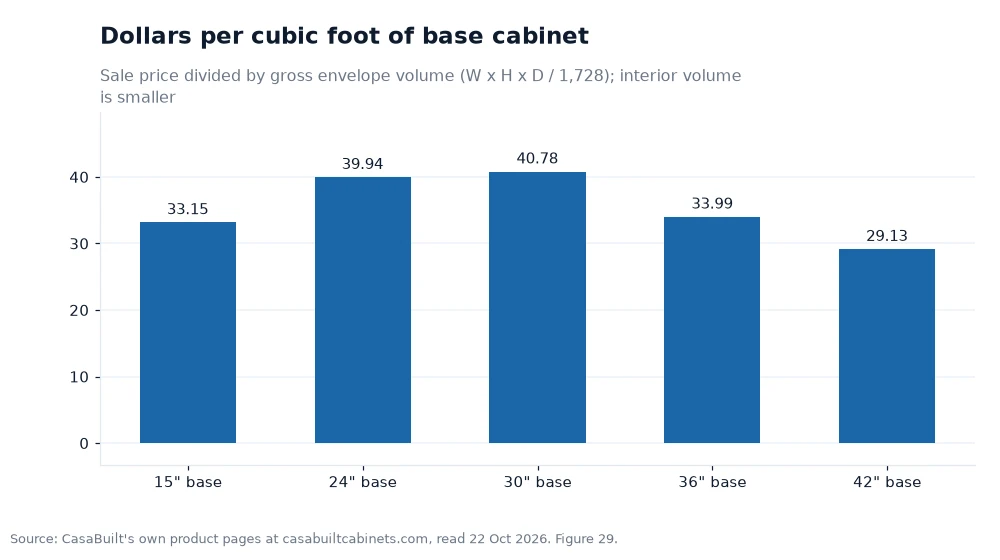
Humidity is a reason to think about volume, because every cubic foot inside a box is a cubic foot that has to be kept dry. The chart prices that volume by dividing each published sale price by the gross envelope of the cabinet: width times 34-1/2 inches of height times 24 inches of depth, divided by 1,728 cubic inches in a cubic foot. It is a comparison tool, not a material cost, and the usable interior is smaller than the envelope.
| Base width | Envelope | Sale price | Per cubic foot |
|---|---|---|---|
| 15 in | 7.19 cu ft | $238.24 | $33.15 |
| 24 in | 11.50 cu ft | $459.26 | $39.94 |
| 30 in | 14.38 cu ft | $586.28 | $40.78 |
| 36 in | 17.25 cu ft | $586.28 | $33.99 |
| 42 in | 20.13 cu ft | $586.28 | $29.13 |
The pattern is set by price bands, not by volume. The 30, 36 and 42 inch cabinets share one published price of $586.28 because they sit in the same width band, so the widest box in that band returns the most storage for the money. The 24-inch cabinet is priced at $459.26 and lands near the top of the range per cubic foot, and the narrow 15-inch cabinet is cheap in total but expensive per cubic foot of space.
Worked example
Take the 30-inch base first. Its envelope is 30 x 34.5 x 24 = 24,840 cubic inches. Divide by 1,728: 24,840 / 1,728 = 14.375 cubic feet. The published sale price is $586.28, so the cost per cubic foot is 586.28 / 14.375 = $40.78, which is the chart value.
The rest follow the same two operations. At 15 inches: 15 x 34.5 x 24 = 12,420 / 1,728 = 7.1875 cubic feet, and 238.24 / 7.1875 = $33.15. At 24 inches: 24 x 34.5 x 24 = 19,872 / 1,728 = 11.5 cubic feet, and 459.26 / 11.5 = $39.94. At 36 inches: 36 x 34.5 x 24 = 29,808 / 1,728 = 17.25 cubic feet, and 586.28 / 17.25 = $33.99. At 42 inches: 42 x 34.5 x 24 = 34,776 / 1,728 = 20.125 cubic feet, and 586.28 / 20.125 = $29.13.
The spread between the dearest and the cheapest is $40.78 - $29.13 = $11.65 per cubic foot, and 11.65 / 40.78 = 28.6 percent. Put another way, the 42-inch cabinet holds 20.125 - 11.5 = 8.625 more cubic feet than the 24-inch cabinet for $586.28 - $459.26 = $127.02, which is $14.73 for each extra cubic foot. In a humid room that is the volume you will be sealing, ventilating and checking for leaks, so it is worth buying deliberately rather than by habit.
Frequently asked questions
Can plywood cabinets be used next to a shower or a sink?
Yes, with the same precautions any cabinet needs: fix leaks quickly, keep the room ventilated and avoid trapping damp air against a cold wall. Plywood resists edge swelling better than a glued chip panel, but no wood cabinet is waterproof, and a persistent leak will damage any of them.
Does the paint finish protect the cabinet from steam?
It protects the painted faces. CasaBuilt finishes the doors with seven layers of paint and a UV protective topcoat, and color-matches the exterior sides. Cut edges and the natural birch interior are not sealed to the same standard, which is why the sink base and the dishwasher bay need watching.
Is a wider cabinet better value in a humid kitchen?
Per cubic foot, yes. The 30, 36 and 42 inch bases share a $586.28 price, so the 42-inch box returns space at $29.13 per cubic foot against $40.78 for the 30-inch. Whether that space is useful depends on the wall and on how much ventilation the run gets.
Keep the room dry and the edges sound
Choose the panel material for the parts you cannot see, then spend the effort on the three wet zones where water actually arrives. Check the trap once a year, leave an air gap at a cold exterior wall, and run the extractor while the pans are on. A cabinet built from layered plywood and kept dry will outlast one built from a cheaper panel and left damp, whatever the door is made of.
Figures quoted here come from the manufacturer's own website, read 22 Oct 2026[1].