Pool Hashrate, Pool Luck, and the Wait for 0.001 BTC
A 250 TH/s miner reaches 0.001 BTC in 8.9 days, worth $84.69 at $84,692, and no amount of staring at the pool dashboard will move that by an hour. What the page shows — Pool Hashrate and Pool Luck — answers a different question from the one most new arrivals are asking. Mistaking it for a progress bar is the usual first error.
Key takeaways
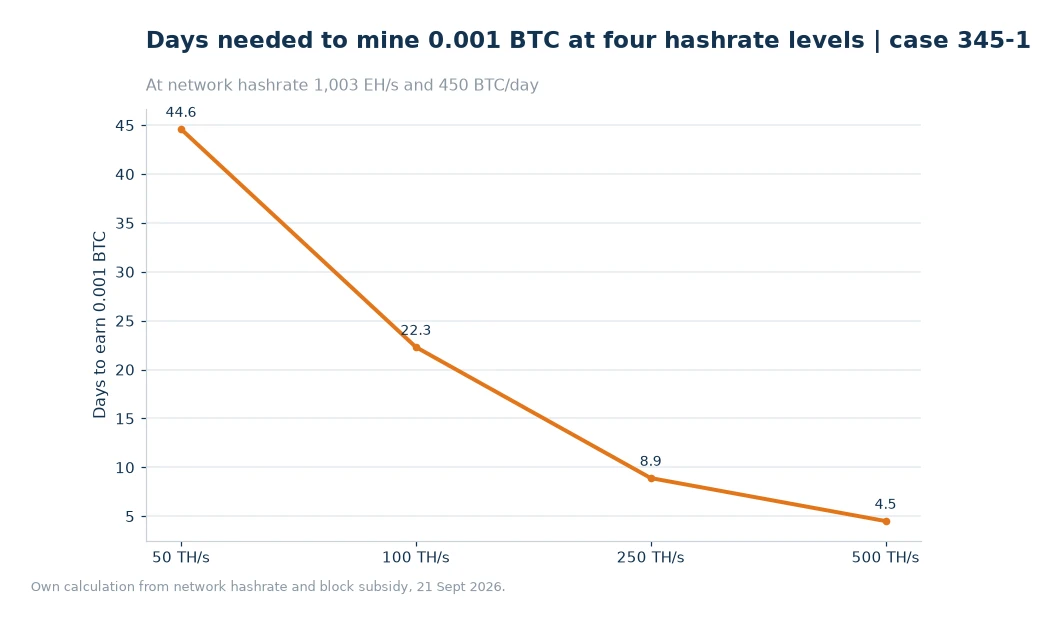
- 0.001 BTC takes 44.6 days at 50 TH/s, 8.9 days at 250 TH/s and 4.5 days at 500 TH/s.
- Pool Hashrate sets how often the pool finds blocks, not how much your shares are worth.
- Pool Luck changes PPLNS income inside the last five difficulty rounds and leaves PPS+ hourly credits untouched.
- A 10% rise in network hashrate turns 8.9 days into 9.8; a 90% uptime month turns it into 9.9.
The page measures the pool, not your machine
Every number on a pool dashboard belongs to the pool first. Its hashrate, its luck, its block count and its fee revenue are aggregates that include thousands of other miners, and your share of them is a small fraction that the page does not attempt to isolate. That is fine for its purpose and misleading if you read it as a personal scoreboard.
Your own progress lives in three places: the credit history of your account, the daily BTC figure implied by your hashrate against network difficulty, and the payout record in your wallet. None of those requires the pool's aggregate luck to be good. Two of them do not even change when the pool's hashrate changes.
It helps to know what the page is for. A pool publishes its hashrate so prospective miners can judge its size, and its luck so existing miners can see whether block finding is tracking expectation. Both are recruitment and transparency tools. Neither is a per-account report, and a miner who wants a per-account report has to build one from the credit history that is already sitting in the account.
Pool Hashrate and the rhythm of block discovery
Pool Hashrate is the combined hashrate of everyone pointing machines at the pool. It matters because it determines how often the pool, as a group, finds a block. A larger pool finds blocks more regularly and therefore settles more often, which is a convenience rather than a yield.
Under PPS+, the credit depends on your shares and current difficulty, not on whether the pool found anything that hour. That is the point of the scheme: the pool absorbs the variance and charges a listed 4% on the block-reward slice for doing so. A miner on PPS+ can watch Pool Hashrate halve and see no change in the hourly credit, which confuses people until the mechanism is explained once.
The ViaBTC BTC Mining Pool state page puts Pool Hashrate beside Pool Luck, and reading them together is more informative than reading either alone. A pool with rising hashrate and neutral luck is simply growing. A pool with flat hashrate and a lucky streak is a statistical event that will regress.
Pool Luck belongs to PPLNS miners
Pool Luck compares blocks found with the number expected for the pool's hashrate over the same period. Above 100% means more blocks than expected. It is a backward-looking score, and it says nothing about the next block, because the next block is independent of the last one.
For PPLNS miners, luck is not decorative. PPLNS pays after 6 confirmations and shares the miner's slice across the last 5 difficulty rounds, so a stretch of good luck inside that window raises the payout and a stretch of bad luck lowers it. The miner carries that variance and is compensated with a listed 2% rate on the combined reward rather than 4% on the block-reward slice alone.
For PPS+ miners, the same number is context. It explains why a neighbouring PPLNS miner had a good week, and it is a reasonable way to judge whether a pool is performing near its expected block rate. It is not a reason to move hashrate, and treating it as one is how miners end up chasing noise between pools.
There is one honest use for luck beyond curiosity. Over several months, a pool that consistently reports well below 100% is either unlucky in a way that stretches credibility or is misreporting its own hashrate. Neither is common, and neither is provable from a single week. If the figure bothers you, watch it across a quarter before drawing a conclusion, and keep your own payout log as the cross-check.
Four signals, one wait
The table holds the target at 0.001 BTC and the capacity at 250 TH/s, then varies one input at a time. It is a way of seeing which numbers on the dashboard actually touch your calendar and which ones only describe the pool's weather.
| Signal | What it measures | Effect on the 8.9-day wait |
|---|---|---|
| Pool Hashrate | The pool's combined share of the network | None under PPS+; changes block frequency only |
| Pool Luck | Blocks found against the pool's expectation | Shifts PPLNS payouts inside the 5-round window |
| Network hashrate | 1,003 EH/s across all miners | A 10% rise stretches 8.9 days to 9.8 |
| Your uptime | Hours your machines actually submitted | 90% uptime stretches 8.9 days to 9.9 |
Worked example
Check the 250 TH/s row from the first principles, then look at what happens at the edges of the table.
- Daily BTC per TH/s: 450 ÷ 1,003,000,000 = 0.00000044865.
- 250 TH/s: 250 × 0.00000044865 = 0.00011216 BTC a day.
- Hourly credit: 0.00011216 ÷ 24 = 0.00000467 BTC.
- Days to 0.001 BTC: 0.001 ÷ 0.00011216 = 8.92, rounded to 8.9.
- In hours: 8.92 × 24 = 214 hours of credited running time.
- At 50 TH/s the same target takes 0.001 ÷ 0.00002243 = 44.58 days, and at 500 TH/s it takes 4.46 days.
- Dollar value: 0.001 × 84,692 = $84.69.
- Gross-up for the listed 4%: 8.9 ÷ 0.96 = 9.3 days, so the net target lands about half a day later.
The 214-hour figure is the useful one for a dashboard habit. If the account shows 190 credited hours after nine days, the gap is uptime, not pool luck, and the fix is local: a flaky power supply, a thermal throttle, a network drop. Chasing that gap on the pool page will never close it.
Frequently asked questions
Does a higher Pool Hashrate mean I earn more?
Not under PPS+, where your credit follows your shares and current difficulty; a larger pool finds blocks more often, but the 0.001 BTC wait at 250 TH/s stays at about 8.9 days.
Should I switch pools when Pool Luck is low?
Usually not. Luck is a backward-looking measure of blocks found against expectation, and for PPLNS it affects the last five difficulty rounds; switching after a poor stretch is chasing a number that has already happened.
Which number on the page reflects my own shortfall?
None of them directly. Compare your credited hours with elapsed hours — at 250 TH/s, 0.001 BTC needs about 214 credited hours — and treat any shortfall as an uptime or hardware issue on your side.
Log the payout, not the refresh
Set one weekly appointment to check the account: credited hours, payout total, and the wallet balance after settlement. Compare those three against the calendar rather than against the pool page, and write the difference down. After a month you will have a record that answers the question the dashboard cannot, which is whether your own operation behaved as planned.
The ViaBTC Statistics page is the better place to watch network-level numbers, and the Profit Calculator will turn a hashrate into a daily figure at current difficulty whenever you need to re-baseline. Neither is a substitute for the weekly log, but both are quicker than guessing.
Sources: the ViaBTC pool state, statistics and fee pages for Pool Hashrate, Pool Luck and the listed 4%[1]. Chain inputs read 21 Sept 2026: network hashrate 1,003 EH/s, difficulty 132.76 T, subsidy 3.125 BTC per block, 144 blocks a day, BTC $84,692. Published 24 Oct 2026. Day counts assume continuous uptime and no fee adjustment unless stated.